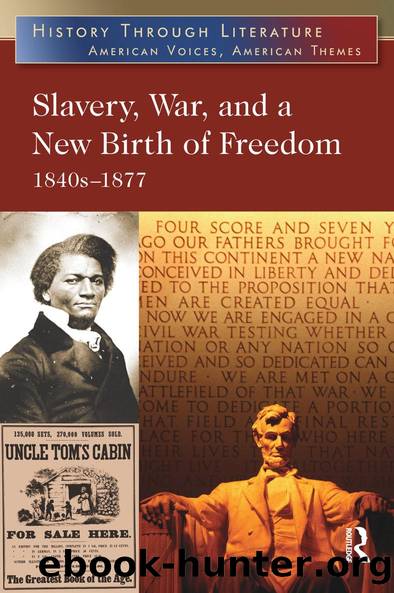
Slavery, War, and a New Birth of Freedom by Jeffrey H. Hacker
Author:Jeffrey H. Hacker [Hacker, Jeffrey H.]
Language: eng
Format: epub
ISBN: 9780765683243
Barnesnoble:
Publisher: Taylor & Francis
Published: 2013-11-30T00:00:00+00:00
Howe, Julia Ward
(1819â1910)
A prominent New England abolitionist, social reformer, and poet, Julia Ward Howe is best known for her lyrics to the âBattle Hymn of the Republic,â which inspired Union forces during the Civil War and remains a popular patriotic song to the present day.
A native of New York City, she was born on May 27, 1819, to Samuel Ward, a successful Wall Street banker, and Julia Rush Cutler, a published poet. Reared by governesses after the death of her mother in 1824, she spent her childhood studying Greek and Romance languages with tutors and attended a private school on Fifth Avenue. Reading in the home library, she taught herself math and scienceâ which were excluded from the curriculum of female studentsâand immersed herself in philosophy, the classics, and contemporary European literature. Thoughtful, independent-minded, and aspiring to the life of a writer, she abandoned her fatherâs puritanical Calvinism for Unitarianism, began writing verse, and submitted original criticism to the Literary and Theological Review and the New York Review.
In early 1843, she met and married physician and reformer Samuel Gridley Howe, who was 18 years her senior. She called him âChevâ for his honorary title of chevalier in the Greek Revolution during the 1820s. The couple lived in Boston, where Samuel Howe had founded the New England Asylum for the Blind (later the Perkins School for the Blind), the first institution of its kind in America. The couple would have six children together, from 1844 to 1858.
In 1851, Samuel also helped found the Daily Commonwealth, a leading abolitionist journal, which he edited for the next two years with Juliaâs assistance. In the meantime, unknown to her husband, she was composing personal spiritual verse that appeared in her first published collection, Passion-Flowers, in December 1853. Reflecting her desire for a career outside the home, which her husband flatly opposed, one poem in the collection, âThe Heartâs Astronomy,â acknowledged her ambivalence toward motherhood and her yearning for intellectual liberation.
In 1856, her five-act play Leonora, or the Worldâs Own pondered questions of gender identity and self-assertion on the stage in New York and Boston. The Howesâ marriage remained stormy, as Julia struggled for the independence, respect, and understanding that conventional morality denied to most women in nineteenth-century America.
Exceedingly well-read and fluent in seven languages, Howe developed friendships with many of Bostonâs intellectual elite, including fellow Unitarians and abolitionists William Ellery Channing, Thomas Wentworth Higginson, and Theodore Parker. In 1860, with the conflict over slavery pushing the nation to the brink of war, she became a particular admirer of radical abolitionist William Lloyd Garrison and an active participant in the Underground Railroad.
On November 18, 1861, with the war under way, Julia and Samuel Howe visited Washington, D.C., to review Union troops and to meet President Abraham Lincoln at the White House. Inspired by the visitâ and encouraged by traveling companion and abolitionist James Freeman Clarke to write a soldiersâ song to the tune of âJohn Brownâs Bodyââshe penned the lyrics to âBattle Hymn of the Republicâ early the next morning at the Willard Hotel.
Download
This site does not store any files on its server. We only index and link to content provided by other sites. Please contact the content providers to delete copyright contents if any and email us, we'll remove relevant links or contents immediately.
The Vikings: Conquering England, France, and Ireland by Wernick Robert(84384)
Ali Pasha, Lion of Ioannina by Eugenia Russell & Eugenia Russell(40321)
The Conquerors (The Winning of America Series Book 3) by Eckert Allan W(37986)
The Vikings: Discoverers of a New World by Wernick Robert(37007)
Cecilia; Or, Memoirs of an Heiress — Volume 1 by Fanny Burney(32638)
Cecilia; Or, Memoirs of an Heiress — Volume 2 by Fanny Burney(32013)
Cecilia; Or, Memoirs of an Heiress — Volume 3 by Fanny Burney(31997)
Empire of the Sikhs by Patwant Singh(23138)
The Secret History by Donna Tartt(19311)
Hans Sturm: A Soldier's Odyssey on the Eastern Front by Gordon Williamson(18652)
Cat's cradle by Kurt Vonnegut(15446)
Pimp by Iceberg Slim(14686)
Sapiens: A Brief History of Humankind by Yuval Noah Harari(14466)
Norse Mythology by Gaiman Neil(13459)
Talking to Strangers by Malcolm Gladwell(13445)
Leonardo da Vinci by Walter Isaacson(13413)
4 3 2 1: A Novel by Paul Auster(12520)
Underground: A Human History of the Worlds Beneath Our Feet by Will Hunt(12148)
The Radium Girls by Kate Moore(12096)
